©

Artoff1478 1

The Christmas spirit in Provence

Ajouter aux favoris

The Christmas season in Provence stretches from Saint Barbara’s Day to Candlemas, with a succession of traditions, festivals, rituals and customs bringing towns and villages to life. ‘Bòn Nové’ – here in Provence, that’s how we say ‘Merry Christmas’!

St Barbara’s Day  Sowing the seeds of a bountiful harvest

The Christmas countdown begins on 4 December, St Barbara’s Day. On that day, a few grains of wheat are sown in several saucers, on a bed of fresh moss.

Over the 20 days between Saint Barbara’s Day and Christmas, these seeds will grow into lovely green shoots, heralding future harvests.

On 25 December, if the grains have sprouted well, it is said that the harvest will be a good one. The finest of the saucers will be placed on the Christmas table, whilst the others will go into the nativity scene, amongst the rocks and bushes.

Sainte-Luce  Warding off winter

The Feast of Saint Lucy, which takes place on 13 December, marks the first stirrings of winter. The arrival of winter is heralded by the gathering of mistletoe and holly, which owe their sacred status to ancient pre-Christian beliefs.

The Druids believed mistletoe possessed miraculous powers; it is hung above doorways before Christmas as a symbol of peace and goodwill. Holly has deep spiritual significance; it represents Moses’ burning bush and Christ’s crown of thorns. It is believed to ward off witchcraft.

The arrival of winter heralds the cold, which gives rise to all manner of superstitions. On Saint Lucy’s Day, lighting candles or lanterns in one’s window is a way of warding off winter’s ill fortune.

The nativity scene and the nativity figures  A living heritage

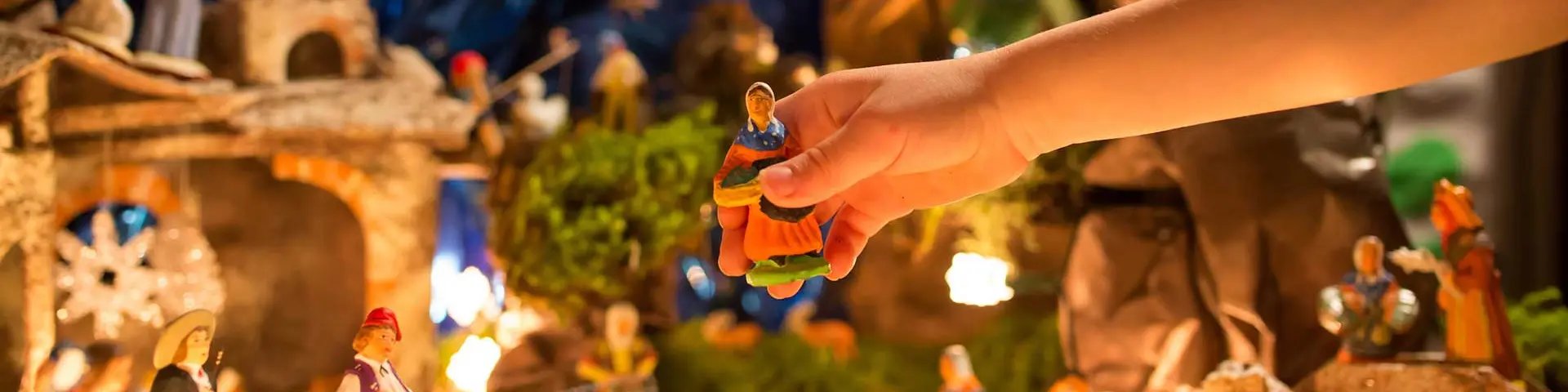
Once Saint Barbara’s Day has passed, it is time to ‘set up the nativity scene’. This is an important part of family life in Provence, as the santons are passed down from father to son.

The origins of the nativity scene go back a very long way. Its invention is attributed to Saint Francis of Assisi, who had the Nativity story re-enacted in an abandoned stable using live people and animals. With the Revolution, the custom arose of setting up a nativity scene in every home, and this beautiful Provençal tradition soon spread to all regions of France.

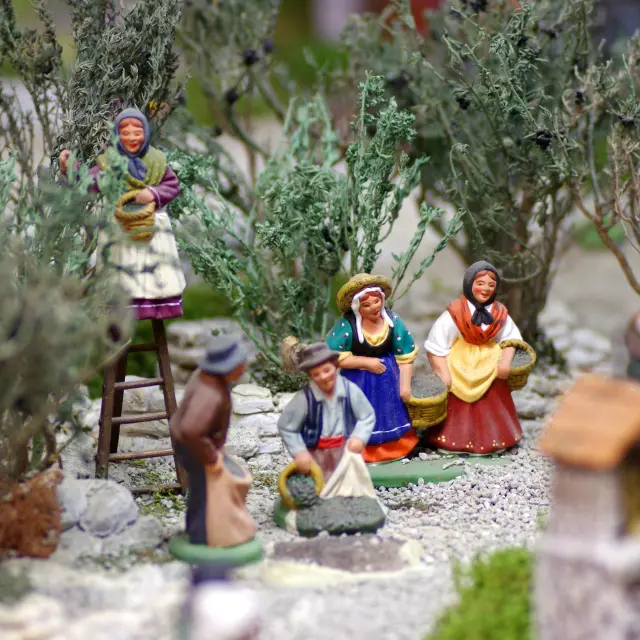
The authentic nativity scene is, in fact, an idealised representation of a Provençal village where everyone has their place, including the animals. The setting is a two-part depiction of community life, with its houses, well, oven, mill, pine trees and olive trees… and a stable with the Baby Jesus, Mary, Joseph, the donkey and the ox, and the star that will guide the Three Wise Men and the villagers who come to visit them. The nativity scene is ‘taken down’ on Candlemas Day.

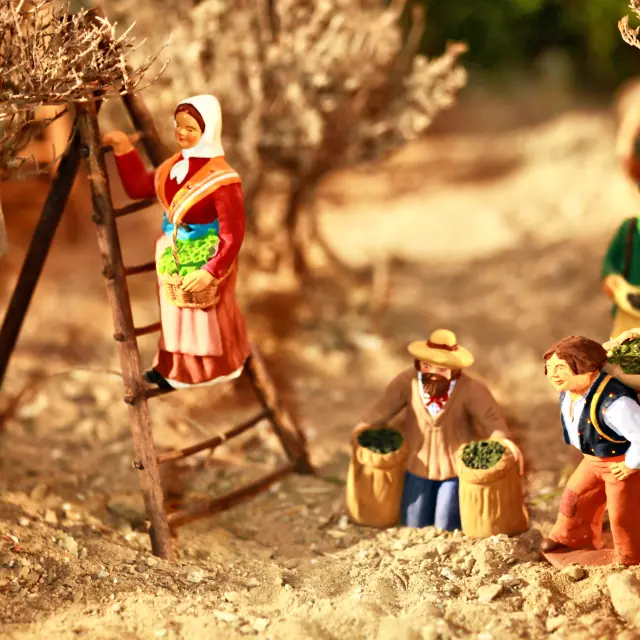
But the nativity scene is, above all,the‘santon’– ‘santoun’ in Provençal, meaning ‘little saint’ – whichis cast from an original mould depicting a variety of popular Provençal figures.

A few characters  with evocative names

Roustido, the friendly middle-class lady with a red umbrella held by her husband,
Bartomiou, an incorrigible drunkard, wearing a long cotton cap, who presents the Baby Jesus with a flat, dried cod,
Pistachié, the tall, lanky fellow leading a donkey laden with sacks of wheat,
Lou Ravi, who raises his arms to the sky in a gesture of admiration,
The bakerand his basket of fougasses,
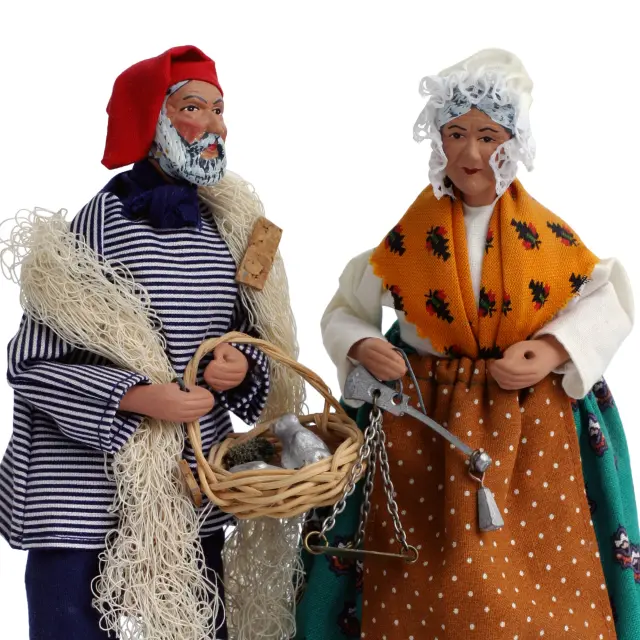
And the garlic seller, the fishmonger, the farmhandscarrying the lantern,the fisherman withhis net over his shoulder,the worshippers(figures on their knees)…

The santon is a purely Provençal phenomenon that forms an integral part of the Calendales traditions. Naive and amusing, familiar yet dignified, these little figurines have long been a source of joy for the children of Provence, before going on to intrigue and then touch the hearts of adults.